My daughter was two and a half when I handed her a small watering can and pointed at the herbs on our kitchen windowsill. I expected a flood. Maybe a fistful of pulled basil leaves. What I got instead was twenty focused, careful minutes, a damp-but-alive rosemary plant, and a child who told every adult she met for the next three weeks that she "takes care of the plants." I had not called it a job. She called it a job. And I nearly missed the whole window because I assumed she was too young to do anything real.
That assumption is the mistake most of us make with chores for toddlers. We push the starting line back to kindergarten, to age five or six, when kids can "actually help." But that is not what the research says. And it is not what I have seen watching families try to build habits later and wondering why it feels like pulling teeth. Toddlers between two and three are in one of the most open windows for absorbing what it feels like to contribute to a family. Not just to feel capable. To feel needed. There is a real difference between those two things, and it matters more than any chore chart on the market will tell you. If you want a guide to building lifelong chore habits, the place to start is right here, right now, with a dustpan and a two-year-old who still thinks sweeping is fun.
Why Toddler Chores Are About Contribution, Not Competence
Steve Biddulph, in his book Raising Boys, keeps circling back to the same point. Children who are given real household tasks, not pretend play versions of tasks, develop a genuine sense of contribution to the family. Competence is "I can do this." Contribution is "my family needs me to do this." Toddlers feel that distinction. They may not have the words for it, but watch a two-year-old's face when she puts the napkins out and the table is then set for dinner. That is not just pride. That is belonging.
This is the angle most chore-chart guides skip entirely. They give you lists. Age-appropriate tasks, star stickers, reward schedules. Those things can work. But the deeper reason to start chores for toddlers early has nothing to do with getting help around the house.
It has to do with who your kid thinks they are inside your family.
The Chores That Actually Work at This Age
Real tasks for toddlers are small, physical, and connected to something the family visibly needs. The Raising Children Network recommends starting with things like tidying up toys, helping put laundry in the washing machine, and filling a pet's water bowl for ages two and three. Preschoolers at four and five can take on setting the table, sorting clean clothes into piles, and helping put away groceries.
Here is a practical breakdown:
| Age | Chores That Work | What to Expect |
|---|---|---|
| 2 years | Putting toys in a bin, carrying their plate to the sink, wiping spills with a cloth | Slow, imperfect, very proud |
| 3 years | Sorting laundry by color, filling a pet's water bowl, placing napkins on the table | Needs reminders, loves repetition |
| 4 years | Setting the table, dusting low shelves, watering plants, putting away groceries | Can handle a two-step task |
| 5 years | Helping fold laundry, clearing the full dinner table, feeding pets independently | Ready for a regular assigned job |
The rule I use: if the outcome is visible and the family notices it, it qualifies. A lumpy pile of sorted laundry is a real contribution. A toy vacuum pushing pretend dirt around is not.
KidKarma makes it easy to assign and track these age-appropriate chores, so your toddler can see their jobs clearly and feel the satisfaction of checking them off.
The Problem-Solving Bonus Nobody Mentions
Here is the thing that surprised me most when I started reading the research.
A study published in Acta Psychologica (ScienceDirect, 2025) examined 125 preschool children with an average age of just over four years old. It found a significant positive relationship between involvement in household chores and problem-solving ability. The kids who did real household tasks performed meaningfully better on problem-solving assessments. And the effect was stronger when parents used what researchers call "scaffolding," guiding the child at the start of a task and then stepping back as the child gained confidence.
That pattern will feel familiar if you have ever done a chore alongside a toddler. You show them how to sort the socks. You sort two together. Then you hand them a sock and watch. Then you fold your own laundry next to them while they work. That gradual release is not just good parenting instinct. It is the actual mechanism that builds problem-solving capacity.
So when your three-year-old is standing at the bathroom sink trying to figure out how to squeeze the toothpaste cap back on, that is not an annoying interruption to bedtime. That is problem-solving. In real time.
How Parental Scaffolding Changes Everything
The same ScienceDirect study found that high levels of parental scaffolding, across cognitive, emotional, and autonomy support, had the strongest effect on the chores-to-problem-solving relationship. In practical terms: help your toddler understand the task, stay emotionally present while they try it, and resist the urge to swoop in and finish it for them.
That last part is hard. I know. I have re-folded towels. I have re-sorted socks. I have re-wiped a counter that a three-year-old considered clean. What changed for our family was deciding that the process mattered more than the counter.
What the Global Data Actually Says
A 2025 study published in Humanities and Social Sciences Communications analyzed responses from 5,024 children across Ghana and found that 90.4% participated in household chores. Boys and girls both participated at high rates (89.2% and 91.5%, respectively), reflecting how deeply embedded real household contribution is in many cultures around the world.
The takeaway for families in the U.S. is worth sitting with. We have largely moved chores to the margins of childhood. Other cultures have not, and their children are not worse for it. Most are better.
How to Introduce Chores Without the Meltdown
Start with one task. One. Not a chore chart with nine items and color-coded columns. One thing your toddler does at a specific, predictable time each day.
Dinner is a good anchor point. A two-year-old can carry their own plate to the sink every night. Every night. Not sometimes. Every time. Predictability is what makes it stick. After three weeks, it is just what happens.
Here is what actually works, based on what I have tried and what the Raising Children Network recommends for toddler chore routines:
- Do it together first. Side by side, not with instructions shouted from another room. Biddulph's research notes that children, boys especially, open up and engage during side-by-side activity far more than during face-to-face conversation. The laundry basket on a Tuesday morning is a relationship waiting to happen.
- Name the job. "This is your plant job." "You are our napkin person." When a toddler has a named role, it becomes part of their identity, not a chore.
- Let it be imperfect. The crumbs your toddler sweeps are still on the floor. The pet bowl is lopsided. That is fine. The point is the doing, not the result.
- Skip the gold-star lecture. Saying "great job!" after every task trains them to look for external approval. A simple "thank you, that really helped" connects their effort to the family's actual need.
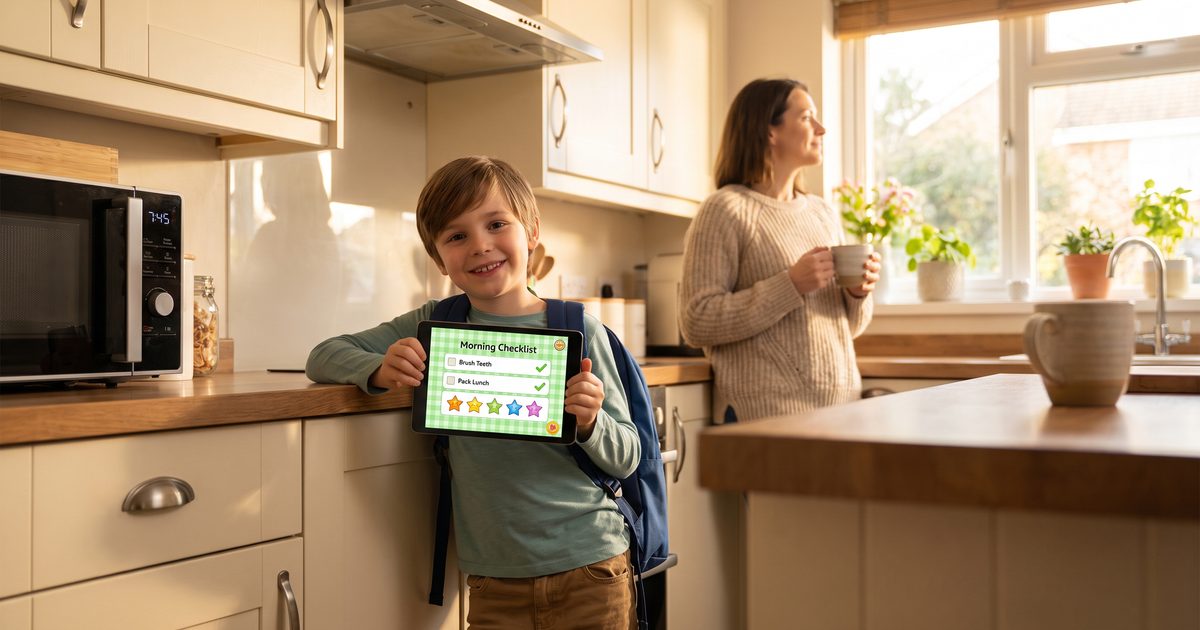
- Keep a visual record. Toddlers cannot read a chore list, but they can see a sticker on a chart or a completed task on an app. KidKarma's visual chore tracking was built specifically for this, making the whole thing feel like a game your toddler actually wants to play.
One more thing. If your toddler flatly refuses some days, that is normal. Do the chore yourself, right next to them, without making a production of it. The routine stays intact. The invitation stays open.
Get Started With KidKarma
If you want to make chores for toddlers feel less like a battle and more like something your kid actually looks forward to, try KidKarma. It's built around exactly what toddlers need: simple visual tasks, a sense of progress they can see, and a way for parents to assign age-appropriate jobs without rebuilding the system every week. Chores made fun for kids. Really.
The dustpan is not the point. The kid who picks it up every morning because that's their job, that's the point.