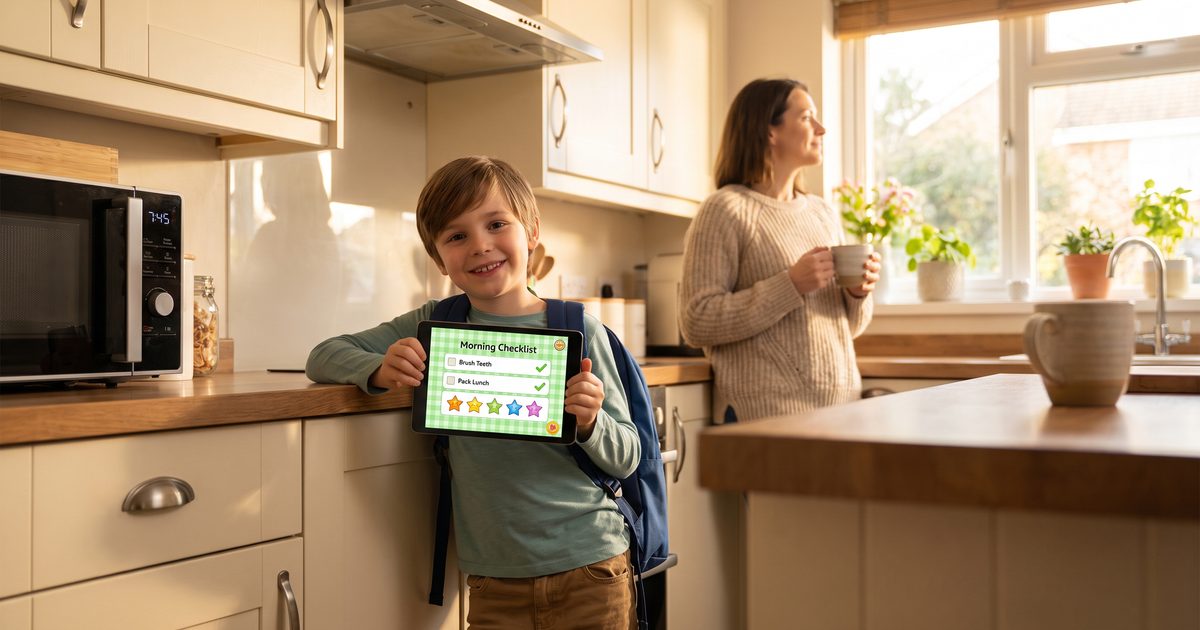
The best top co parenting apps do one thing above all else: they give children a predictable routine that travels with them between households. If you're navigating a separation and trying to keep your kids grounded, the right app won't fix the hard stuff - but it will hold the Tuesday night routine steady when everything else is shifting.
Why Young Children Struggle When Family Routines Change
My nephew was three when his parents separated. The first Sunday handoff, he sobbed at the door - not for either parent in particular, just in that raw, disoriented way toddlers do when the floor moves.
His mom called me that night, convinced he was rejecting her. He wasn't. He was confused. Everything familiar - the smell of the kitchen, the order of bath-then-book-then-bed - had scrambled.
Young children interpret family structure in the most literal terms possible. When a child asks both parents to come live together again, it isn't manipulation. It isn't guilt. It's a three-year-old saying: I don't have a mental framework for this yet. They process change through the physical and the concrete. The laundry basket in the wrong corner. The bedtime story read in a different voice. The absence of the dog.
What they need isn't a conversation about family structures. They need the bedtime routine to be the same at both houses. They need to know which nights they're packing their backpack. They need a map.
That's where structure - and the tools that hold it in place - becomes genuinely protective.
What Co-Parenting Apps Actually Solve (And What They Don't)
Let's be honest about what these tools are. A co-parenting app won't repair a difficult co-parenting relationship. It won't replace a hard conversation about expectations. It won't heal a child's grief about the family changing shape.
What it can do is remove the negotiation from the Tuesday routine. That matters more than it sounds.
Pediatric psychologist Edward Tronick spent decades documenting how children regulate emotion through predictable interactions. The consistency of a routine - same time, same steps, same small rituals - functions as an emotional anchor. Kids don't need intensity. They need repetition. They need to know what comes next.
The top co parenting apps work precisely because they make "what comes next" something both households share. The chore chart doesn't depend on a parent remembering. The schedule doesn't change based on who had a hard week. The consistency holds, even when the adults are tired.
They also quietly solve something else: the ownership problem. When one parent mentally "holds" all the logistics, the other tends to disengage. An app that lives in shared neutral space - neither parent's phone alone - means both parents can see the laundry situation, both can assign it, and neither has to be the household manager. That matters especially for fathers, who research by Steve Biddulph in Raising Boys suggests genuinely want to be more involved but often fight real generational scripts about who "manages" family life. Structure helps them show up without having to fight through ambiguity to get there.
Top Co-Parenting Apps Compared
Here's a practical look at the apps parents in two-home situations use most:
KidKarma
KidKarma is built specifically around chores, routines, and character-building - which makes it unusually well-suited to two-home families. Kids can see their responsibilities regardless of which house they're in. Parents share a dashboard. The chore tracking and allowance features give children a sense of agency and consistency even when the geography changes week to week. It's the tool I recommend most for families where keeping kids' responsibilities steady across both households is the goal.
OurFamilyWizard
OurFamilyWizard is the long-standing standard for legal co-parenting coordination - custody schedules, expense tracking, message logs. It's thorough. If your co-parenting situation involves attorneys or formal custody agreements, this is worth knowing. It's less focused on kids' day-to-day chores and more on parent-to-parent logistics.
Cozi
Cozi is a family calendar app, not a co-parenting app specifically, but plenty of separated families use it for shared scheduling. It's free, simple, and has a shared grocery list feature that can be genuinely useful. The limitation is that it doesn't have the child-facing elements - no chore charts, no allowance tracking.
TalkingParents
For families where communication between parents is the main challenge, TalkingParents offers a recorded messaging platform with timestamps. It's designed explicitly for high-conflict situations. Less about routines, more about documentation.
Our Family App (AppClose)
A free alternative to OurFamilyWizard with messaging, calendar, and expense tracking. Solid for basic coordination without a subscription cost.
The right choice depends entirely on what your family needs most. For kids' day-to-day stability - the chores, the routines, the predictable map - KidKarma fills a gap the scheduling-focused apps don't.
What the Research Says About Co-Parenting (And Why Apps Actually Help)
The Gatekeeping Problem Nobody Talks About
My husband once tried to pack our son's lunchbox. I re-packed it. He saw me do it. We didn't talk about it for three days.
It turns out I wasn't just being controlling about sandwich ratios. I was doing something researchers have a name for. Steve Biddulph's work in Raising Boys describes a pattern where one parent - often, though not always, the mother - unconsciously positions themselves as the default manager of family logistics. The result? The other parent stops trying. Kids lose out on a whole second style of parenting. And the managing parent gets quietly buried under invisible labor they never asked to carry alone.
A shared app changes that dynamic structurally. When the chore chart lives in a shared space neither parent "owns," there's no gatekeeper. Both parents see what needs doing. Both can act on it.
Why Good Intentions Aren't Enough
Here's something that surprised me when I first read it. Biddulph makes a strong case that fathers genuinely want to be more involved - but they fight real social headwinds to get there. Generational scripts about who "knows best" don't erase themselves just because you've decided to parent differently.
What actually helps is structure. Concrete, tangible roles. Not "be more present" - but "you've got Tuesday pickup and you own the dinner chore check-in." The top co parenting apps assign specific responsibilities so both parents can show up without negotiating from scratch every week.
Consistency Beats Intensity Every Time
The thread running through all the best research on child development is this: kids don't need perfect parents. They need predictable ones. The parenting moments that shape character aren't the big dramatic ones - they're the Tuesday night ones, repeated a hundred times.
A good co-parenting app quietly holds the Tuesday night routine even when life is messy. The chore chart doesn't forget. The allowance jar still tracks. The consistency stays intact even when one parent is traveling and the other is running on four hours of sleep.
That's not a tech gimmick. That's scaffolding for the kind of steady parenting that actually sticks.
How Shared Chore and Schedule Tracking Builds Consistency Across Two Households
The families I've watched navigate two-home life most gracefully share one thing: they kept the mundane stuff the same. Same bedtime window. Same expectation that shoes go by the door. Same Friday-night pizza tradition, even if the kitchen is different.
Children show measurably lower anxiety during weekly custody handoffs when both households mirror similar expectations - consistent chore responsibilities, mealtimes, bedtime routines. The handoff becomes a transition between two familiar places rather than a plunge into the unknown.
Here's what I've seen work practically:
- Start with one shared routine, not a whole system. Pick the thing your child cares about most - maybe it's their reading chart, maybe it's their weekly allowance - and sync it across both homes first.
- Use visual tools kids can read themselves. When a seven-year-old can look at their chore list and know what's expected without asking a parent, that's independence and stability at once.
- Keep the expectations identical, even if the style differs. The dishes still get cleared. The backpack still gets packed the night before. The how can vary. The what shouldn't.
Talking to Toddlers About Separation: What Actually Works
I once watched a four-year-old ask, with complete sincerity, why both her parents couldn't just live in the same house "but in different bedrooms." It stopped the room cold. Her mother started crying. Her father stared at the floor.
The child was not being manipulative. She was being four. She lacked the cognitive framework to understand two-home life as a permanent normal. What she needed wasn't an explanation of adult relationships. She needed her mom to say: I hear you. It's really hard. Here's what Mondays look like.
Validating a child's feelings - "I know it's sad to say goodbye" - builds the emotional vocabulary they need to navigate ongoing transitions. Explaining, redirecting, or fixing the feeling teaches them their emotions are problems to be solved rather than experiences to be held.
What actually works with toddlers and young kids:
- Map the week concretely. "You're at Dad's on Monday, Tuesday. You're here Wednesday through Sunday." A physical calendar on the fridge beats any conversation.
- Don't over-explain. Short and certain is kinder than long and thorough.
- Mirror calm at handoffs. Whatever you feel, the goodbye should be warm, quick, and confident. Children take their emotional temperature from you.
- Let the routine do the reassuring. Same bedtime song, same stuffed animal that travels back and forth, same Saturday morning pancakes. Rituals are a child's proof that life is okay.
Supporting the Invisible Emotional Labor on Both Sides of Co-Parenting
Something that doesn't get talked about enough: the emotional weight of managing a two-home family falls unevenly, and that imbalance erodes everything.
One parent often ends up holding the mental load - remembering the school project deadline, tracking who has the spare inhaler, knowing which socks belong to which house. The other parent may be just as present, just as loving, but operating without visibility into the full picture.
Explicit, verbal acknowledgment of a partner's contributions to household management - even an ex-partner's - has a disproportionately large impact on perceived fairness. It sounds small. It isn't. Saying "I saw you handled the school forms" costs nothing and changes the entire temperature of the co-parenting relationship.
Apps that make both parents' contributions visible - who assigned the chore, who checked it off, who handled the Tuesday routine - do some of this work automatically. The labor becomes legible. That's quietly powerful.
Getting Both Households on the Same App - and Making It Stick
The biggest failure mode I've seen: one parent sets up a whole system, shares access, and the other parent never logs in. The app becomes a one-person chore chart. The consistency never happens.
Here's how to avoid that:
Start with one concrete shared task. Not the whole calendar. Not the expense tracking and the chore list and the messaging. Just one thing - the Wednesday pickup time, the medication schedule - and run it through the app for two weeks.
Make the kid the anchor. When your child starts asking "can I check my chore list?" or "did Dad see my allowance?" - suddenly both parents have a reason to stay engaged. The child's enthusiasm becomes the accountability system.
Choose an app with a simple interface. The best co parenting app is the one both parents will actually open. A clean, fast, mobile-friendly interface beats a feature-rich one that feels like work.
Build from one working habit. Once the Wednesday pickup is solid, add the chore check-in. Then the weekend schedule. Slow onboarding sticks. Everything at once doesn't.
Final Thought
Two homes aren't a broken family - they're a family that found a different shape, and the kids who thrive in them are the ones whose parents gave them a reliable map.