If your kids live in two homes, you've probably seen the pattern: chores get done at one house and forgotten at the other, points earned on Monday don't count by Friday, and "Mom lets me skip it" becomes a weekly negotiation. A chore chart for two households fixes this by giving kids one set of expectations, no matter whose house they're at.
TL;DR: Agree on a short list of shared chores, use the same points and rewards in both homes, keep the chart somewhere both parents can see and update (a shared app works best), and let small differences in house rules stay different. Consistency on the what matters far more than matching on the how.
Why Chores Fall Apart Between Two Homes
Chore systems usually break at the handoff, not inside either house. Common reasons:
- Two different charts. Each parent builds their own system, so kids learn two sets of rules and test both.
- Points that don't travel. A sticker chart on one fridge means nothing at the other house, so effort at one home feels wasted.
- No shared visibility. One parent can't see what happened at the other house, so they either re-ask or give up.
- Negotiation by text. Every "did she do her chores?" message is a chance for friction between co-parents.
Kids aren't being manipulative when they exploit the gaps. They're doing what anyone would do with two sets of rules. The fix is structural: one chart, one points balance, both parents looking at the same thing.
What to Keep the Same (and What Can Differ)
You don't need identical households. You need a few shared anchors.
Keep the same in both homes:
- The core daily chores for each child (making the bed, clearing their plate, packing their bag)
- How points are earned and what they're worth
- The rewards kids are working toward
- What happens when a chore is skipped
Fine to differ:
- House-specific jobs (feeding the dog that only lives at Dad's, watering Mom's garden)
- The exact time chores happen
- Small house rules that don't affect the chart
A good rule: if a difference would make a child say "that's not fair," put it on the shared list. If it's just how each house runs, let it be.
How to Set Up a Chore Chart for Two Households
- Agree on 3 to 5 shared chores per child. Start small. You can add more once the system sticks. Use our age-appropriate chores guide to pick realistic tasks.
- Set point values together. Bigger or less-liked jobs earn more. Write the values down so neither parent has to remember.
- Pick shared rewards. Choose rewards that can be redeemed in either home, like screen time, choosing the movie, or an outing. Our guide to reward systems that actually work has ideas.
- Put the chart where both parents can see it. A paper chart can only live in one house. A shared app keeps the chart and points in sync wherever the kids are.
- Decide who approves what. The parent the child is with that day approves that day's chores. Simple, and no one second-guesses the other.
- Review together every few weeks. A 10-minute check-in (by message is fine) to adjust chores as kids grow.
Sample Shared Chore Chart by Age
| Age | Daily chores (both homes) | Weekly chores (either home) |
|---|---|---|
| 3 to 5 | Put toys away, put clothes in hamper, help set the table | Match socks, water a plant |
| 6 to 8 | Make bed, clear own plate, pack school bag | Tidy bedroom, help sort laundry |
| 9 to 12 | Make bed, load or unload dishwasher, pack bag the night before | Vacuum a room, take out recycling |
| 13+ | Keep room tidy, clean up after meals, manage own schedule | Do own laundry, help cook one meal |
For more detail by age, see our chore guides for toddlers, elementary kids, tweens, and teens.
Making Points and Rewards Work Across Two Homes
Points are what make a two-home chart feel fair to kids. If they earn 20 points at Mom's on Tuesday, those points should still be there at Dad's on Thursday. That only works if both parents track the same balance.
A few tips:
- Use one points balance, not two. Splitting points by house makes kids care more about where they are than what they did.
- Let rewards be redeemed in either home. A reward that only exists at one house creates a "favorite house" problem.
- Keep penalties gentle and identical. If a skipped chore costs points, it should cost the same in both homes.
When Co-Parents Disagree About Chores
Disagreements are normal. A few ways to keep them small:
- Argue about the list once, not every week. Agree on the shared chores up front, then let the chart do the enforcing.
- Focus on the child's age, not your house rules. "What can a 7-year-old reasonably do?" is easier to agree on than "how things work at my house."
- Keep the chart out of adult conflict. If you communicate mainly through a co-parenting app, keep chores in their own neutral space so they don't become ammunition. Our roundup of the best co-parenting apps covers tools for the parent-to-parent side.
If you're in a blended family with step-siblings, our guide to building a chore system for blended families covers fairness between kids too.
Using an App for a Two-Home Chore Chart
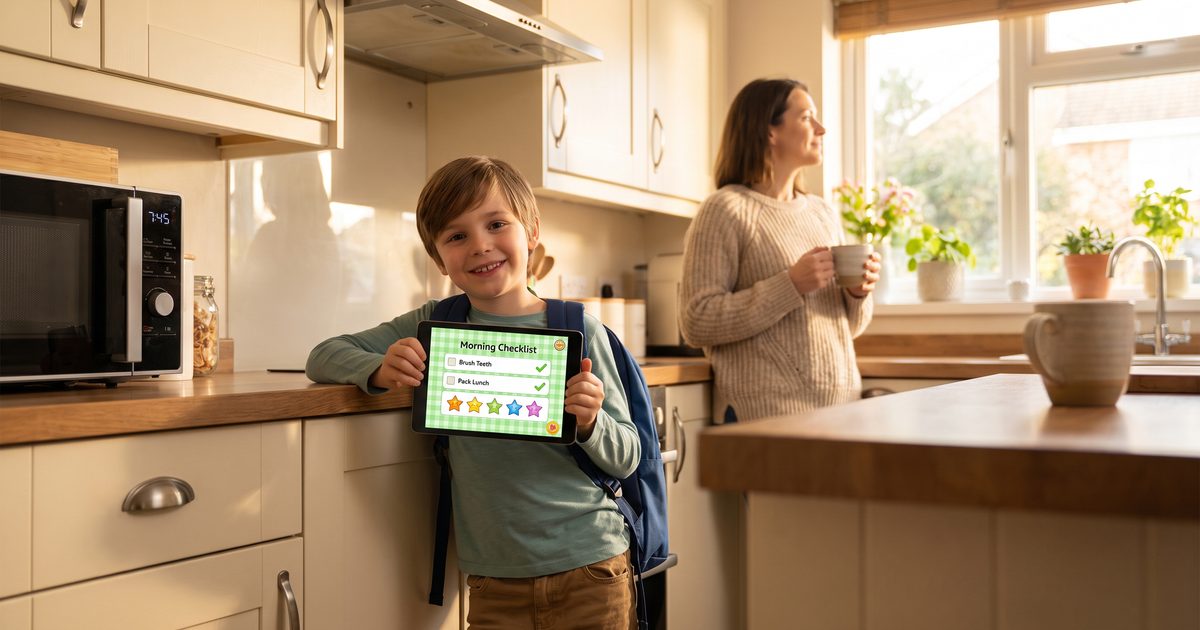
A paper chart can't be in two places at once. A shared chore app can. KidKarma was built for this: Two-Home Sync is included on every plan, so both homes share one chore chart and one points balance. Kids tick off chores wherever they are, the parent they're with approves with one tap, and points spend on rewards you've both agreed on. Younger kids log in by scanning a QR code, so there are no passwords to keep track of across two homes.
KidKarma has a 14-day free trial on iPhone and Android, then plans start at $4.99/month or $29.99/year.
Final Thought
Kids in two homes don't need two identical houses. They need a few things that stay the same wherever they wake up. A shared chore chart is one of the simplest ways to give them that.